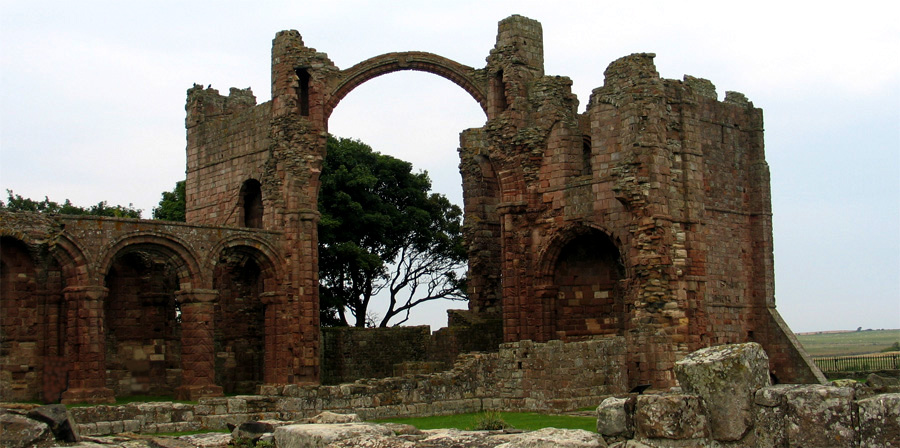
 The monastery of Lindisfarne was founded in 635 A.D. by Irish born St. Aidan, a monk from the monastery of Iona off the west coast of Scotland, at the request of King Oswald of Northumbria. Lindisfarne became the base for the conversion of northern England to Christianity. In its short existence, it was home to several major saints. Notable Bishops of Lindisfarne were St. Finan, St. Eata, St. Colman, and St. Cuthbert, Northumberland's patron saint. Notable saints who were students at Lindisfarne included St. Chad, St. Cedd, and St. Wilfrid. The monastery was eventually abandoned after being ransacked numerous times by Vikings. The monastery was the site of the creation of the illuminated manuscript known as the Lindisfarne Gospels, which today resides in the British Library in London. The priory, the ruins of which can be seen today, was built by Benedictine monks from Durham in the 12th Century.
St. Aidan was responsible, along with his fellow monks, for the establishment of numerous monasteries and churches throughout northern England and southeast Scotland. He died in 651 A.D. in the village of Bamburgh, south of Lindisfarne. The statue of St. Aidan resides near the ruins of the 12th Century priory. St. Cuthbert was Bishop of Lindisfarne for only two years from 685 to 687, but he was nevertheless one of Lindisfarne's most notable personages. Born in Northumbria and educated at Old Melrose, he was responsible during his lifetime for the establishment of numerous monasteries and churches throughout the region. He died in 687 on the island of Inner Farne off the Nortumberland coast from Bamburgh where he retired after leaving his position at Lindisfarne. The patron St. of Northumberland, he is buried in Durham Cathedral where his body was taken by monks fleeing the Viking raids. The statue of St. Cuthbert is by local Northumbrian artist Fenwick Lawson and resides on the grounds of the priory. St. Cuthbert Island lies just offshore from Lindisfarne is accessible at low tide. St. Cuthbert used this small island as a retreat for a short time before moving to the more secluded Inner Farne in the North Sea off of Bamburgh.
The oldest building on Holy Island and the only building that retains work from the Saxon period, the Church of St. Mary the Virgin, was largely a 13th Century creation built over earlier 11th Century fragments. It has been speculated that the church was built around St. Aidan's wooden church, and that St. Aidan worshipped on this site in the early years of Lindisfarne.
Since 2015, two archaeological digs have uncovered significant finds about the early Anglo-Saxon history of Holy Island.
The first archaeological investigation, directed by the Newcastle University archaeologist Richard
Carlton of the Newcastle-based company, Archaeological Practice, Ltd., in 2016 and 2017, uncovered the foundations of a stone church-like building that could date from 630 to 1050 A.D., although an early date was thought the most likely. The site of the excavation is known as Heugh Hill, and the building would have been entirely visible from Bamburgh, the great royal palace of the monks’ initial patron and benefactor, the 7th Century St. Oswald of Northumbria, northeast England’s most significant early Christian king. It has been speculated that "the building was placed on the site of the wooden church built in 635 A.D. by St Aidan." In addition, the excavation also incovered a probable signalling tower 165 feet from the church.
The other archaeological investigation begun in the summer of 2016 by archaeologist David Petts of Durham University in collaboration with the private firm DigVentures opened up three trenches: one on the western side of the village in Glebe Field and two in Sanctuary Close to the east of the ruins of the later medieval priory. The team believed that they have "found evidence for the early monastery" based on the remarkable finds they have uncovered, in particular, a rare grave marker thought to be from the mid-7th-8th Century. Their work comtinued in 2017 and will continue in 2018.
About Lindisfarne The monastery of Lindisfarne was founded in 635 A.D. by Irish born St. Aidan, a monk from the monastery of Iona off the west coast of Scotland, at the request of King Oswald of Northumbria. Lindisfarne became the base for the conversion of northern England to Christianity. In its short existence, it was home to several major saints. Notable Bishops of Lindisfarne were St. Finan, St. Eata, St. Colman, and St. Cuthbert, Northumberland's patron saint. Notable saints who were students at Lindisfarne included St. Chad, St. Cedd, and St. Wilfrid. The monastery was eventually abandoned after being ransacked numerous times by Vikings. The monastery was the site of the creation of the illuminated manuscript known as the Lindisfarne Gospels, which today resides in the British Library in London. The priory, the ruins of which can be seen today, was built by Benedictine monks from Durham in the 12th Century.
St. Aidan was responsible, along with his fellow monks, for the establishment of numerous monasteries and churches throughout northern England and southeast Scotland. He died in 651 A.D. in the village of Bamburgh, south of Lindisfarne. The statue of St. Aidan resides near the ruins of the 12th Century priory. St. Cuthbert was Bishop of Lindisfarne for only two years from 685 to 687, but he was nevertheless one of Lindisfarne's most notable personages. Born in Northumbria and educated at Old Melrose, he was responsible during his lifetime for the establishment of numerous monasteries and churches throughout the region. He died in 687 on the island of Inner Farne off the Nortumberland coast from Bamburgh where he retired after leaving his position at Lindisfarne. The patron St. of Northumberland, he is buried in Durham Cathedral where his body was taken by monks fleeing the Viking raids. The statue of St. Cuthbert is by local Northumbrian artist Fenwick Lawson and resides on the grounds of the priory. St. Cuthbert Island lies just offshore from Lindisfarne is accessible at low tide. St. Cuthbert used this small island as a retreat for a short time before moving to the more secluded Inner Farne in the North Sea off of Bamburgh.
The oldest building on Holy Island and the only building that retains work from the Saxon period, the Church of St. Mary the Virgin, was largely a 13th Century creation built over earlier 11th Century fragments. It has been speculated that the church was built around St. Aidan's wooden church, and that St. Aidan worshipped on this site in the early years of Lindisfarne.
Since 2015, two archaeological digs have uncovered significant finds about the early Anglo-Saxon history of Holy Island.
The first archaeological investigation, directed by the Newcastle University archaeologist Richard
Carlton of the Newcastle-based company, Archaeological Practice, Ltd., in 2016 and 2017, uncovered the foundations of a stone church-like building that could date from 630 to 1050 A.D., although an early date was thought the most likely. The site of the excavation is known as Heugh Hill, and the building would have been entirely visible from Bamburgh, the great royal palace of the monks’ initial patron and benefactor, the 7th Century St. Oswald of Northumbria, northeast England’s most significant early Christian king. It has been speculated that "the building was placed on the site of the wooden church built in 635 A.D. by St Aidan." In addition, the excavation also incovered a probable signalling tower 165 feet from the church.
The other archaeological investigation begun in the summer of 2016 by archaeologist David Petts of Durham University in collaboration with the private firm DigVentures opened up three trenches: one on the western side of the village in Glebe Field and two in Sanctuary Close to the east of the ruins of the later medieval priory. The team believed that they have "found evidence for the early monastery" based on the remarkable finds they have uncovered, in particular, a rare grave marker thought to be from the mid-7th-8th Century. Their work comtinued in 2017 and will continue in 2018.
About Lindisfarne
The Holy Island of Lindisfarne Website
English Heritage: Lindisfarne Priory
Wikipedia: Lindisfarne
New Advent Catholic Encyclopedia: Ancient Diocese and Monastery of Lindisfarne
Wikipedia: Aidan of Lindisfarne
Wikipedia: Cuthbert
Wikipedia: Oswald of Northumbria
About Recent Archaeological Excavations on Lindisfarne
Heddon-on-the-Wall: A Saxon Church on Lindisfarne
Church Times: Archaeologists’ dig reveals ancient Lindisfarne church
Independent UK: One of Britain’s oldest churches discovered on Holy Island of Lindisfarne
Durham University: Lindisfarne: The search for the heart of Anglo-Saxon Northumbria
The Guardian: Archaeologists to launch crowdfunded search for Lindisfarne monastery
Dig Ventures: Lindisfarne Digital Dig Team
Journey to Lindisfarne (Holy Island)
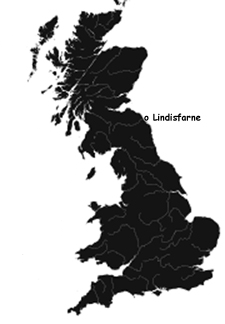
Lindisfarne (Holy Island) is located off the A1 and just offshore of the Northumberland coast in Northeast England. Holy Island is linked to the mainland by a long causeway. Twice each day the tide sweeps in from the North Sea and covers the road to the island.
Streetmap UK NGR NU1289042630.
Visitors Information
Visitors onformation on Lindisfarne may be found on the Holy Island of Lindisfarne website. Included is general travel information, including up-to-date causeway crossing times, information on accommodation and what to see on the island, and information on the religious, cultural, and natural history of the island. General tourist information on the area may be found at the Visit Nothumberland website.
Additional Photos of Lindisfarne
Lindisfarne Priory, Holy Island (2004)
Lindisfarne Priory, Holy Island (2004)
Lindisfarne Priory, Holy Island (2004)
Lindisfarne Priory, Holy Island (2004)
St. Aidan's Statue, Holy Island (2004)
St. Cuthbert's Statue, Holy Island (2004)
Lindisfarne Priory with Lindisfarne Castle in the Distance (2013)
Close-Up of the Rainbow Arch, Lindisfarne Priory (2013)
View of Priory Grounds from the Heugh, Lindisfarne Priory (2013)
Close-Up of Priory Ruins from the Heugh, Lindisfarne Priory (2013)
St. Aidan's Statue, Lindisfarne Priory (2013)
St. Aidan's Statue and Lindisfarne Priory (2013)
The Rainbow Arch, Lindisfarne Priory (2022)
Stone Faces, Lindisfarne Priory (2022)
Close-Up of Stone Face, Lindisfarne Priory (2022)
Night Stairs to Dormitory Sign, Lindisfarne Priory (2022)
Night Stairs to Monks Dormitory, Lindisfarne Priory (2022)
|